Connect with us

Economy

Gold Breaks $4,000 Barrier as Economic and Geopolitical Tensions Escalate

Published

on

fd4f1bf7-3e85-4a59-8939-e3df4e6b0d98

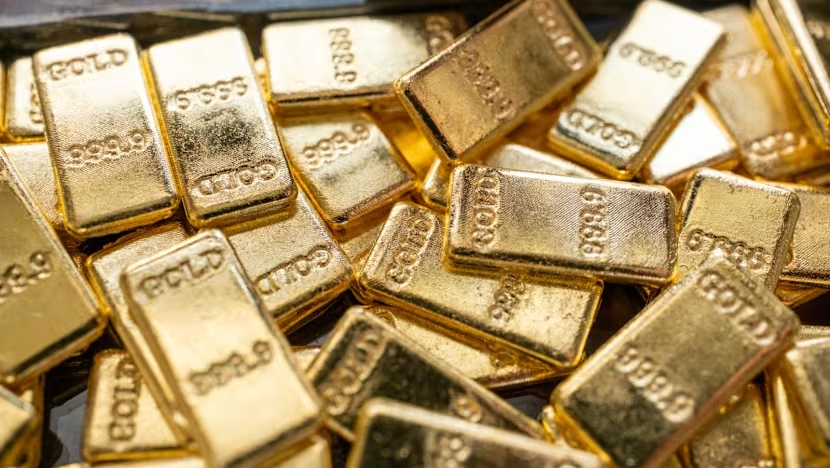
Gold has soared to an unprecedented milestone, surpassing $4,000 per ounce, propelled by a confluence of global economic uncertainty, geopolitical strife, and robust demand from central banks and investors. As a traditional safe-haven asset, gold is experiencing a surge in interest amid volatile markets, heightened focus on artificial intelligence (AI) equities, and concerns over international trade policies.

Record-Breaking Rally

The spot price of gold, reflecting its value for immediate delivery, has climbed above $4,036 per ounce, with gold futures mirroring this trend in early October. This marks one of the most significant rallies in decades, with prices rising approximately 33% since April, when U.S.-imposed tariffs escalated global trade tensions.

U.S. Government Shutdown Boosts Demand

A key driver of gold’s ascent is the ongoing U.S. government shutdown, now in its second week, stemming from disputes over public spending. Historically, such periods of political gridlock have steered investors toward safe-haven assets like gold. For example, during a month-long shutdown in former President Trump’s first term, gold prices rose by nearly 4%, underscoring its appeal during times of instability.

Christopher Wong, a strategist at OCBC, notes, “The government shutdown catalyzes gold’s upward trajectory, as investors seek stability amid political and financial turbulence.” However, Wong warns that a swift resolution to the shutdown could temper this rally.

Central Banks Bolster Reserves

Gold’s long-term strength is further supported by substantial purchases from global central banks. Since 2022, central banks have acquired over 1,000 tonnes of gold annually, a sharp increase from the 481-tonne average between 2010 and 2021. Nations such as Poland, Turkey, India, Azerbaijan, and China are leading this trend, strategically diversifying their reserves to reduce dependence on U.S. treasuries and the dollar.

“Central banks are stockpiling gold to hedge against economic volatility and currency risks,” says Gregor Gregersen, founder of Silver Bullion, a precious metals dealer and storage provider. The firm has seen its client base double over the past year, reflecting growing interest from retail investors and high-net-worth individuals.

Surge in Retail and ETF Investments

Demand for gold extends beyond physical purchases. Gold-backed exchange-traded funds (ETFs) have attracted $64 billion in global inflows this year, according to the World Gold Council. Retail investors, particularly those seeking to shield their portfolios from market swings, are driving this trend. A weakening U.S. dollar has further amplified gold’s allure, making it more affordable for investors holding other currencies and boosting international demand.

Potential Risks Ahead

Despite its robust performance, gold remains vulnerable to market shifts. Experts caution that factors such as rising interest rates, easing geopolitical tensions, or resolutions to political uncertainties could exert downward pressure on prices. For instance, gold experienced a nearly 6% decline in April following a de-escalation of U.S. political tensions, and in 2022, prices fell from $2,000 to $1,600 per ounce after Federal Reserve rate hikes to curb inflation.

Heng Koon How, head of market strategy at UOB Bank, highlights gold’s dual nature: “While gold serves as a reliable hedge against uncertainty, it is not immune to volatility. Shifts in investor sentiment or global economic conditions could trigger price corrections, particularly with retail-driven demand.”

Gold’s Enduring Role

Gold’s status as a global safe-haven asset is reinforced by its historical resilience and its strategic importance in modern financial portfolios. From shielding investors during U.S. government shutdowns to serving as a diversification tool for central banks, gold remains a bedrock of stability in an unpredictable global economy.

Wong of OCBC concludes, “Gold’s role as a safeguard during turbulent times is well-established. While its current rally may face short-term fluctuations, its long-term significance in global investment strategies remains undeniable.”

As trade disputes, geopolitical tensions, and economic uncertainties persist, gold’s appeal as a protective asset is likely to endure, cementing its position as a focal point for investors navigating financial and political risks worldwide.

Continue Reading
Click to comment

Leave a Reply

Your email address will not be published. Required fields are marked *

Economy

Quantum Edge: Rewiring the Future of Global Business

Published

on

1_Ql3GKrNxlzgrRTZcKUbh5A

What if a machine could crack in minutes a problem that would stump today’s fastest supercomputer for longer than the universe has existed? That’s no longer a thought experiment. Quantum computing has left the lab and landed in the C-suite. The rules of strategy are being rewritten in real time.

The leap comes from qubits, not bits. A classical bit is a coin: heads or tails. A qubit is a sphere: every point on its surface at once, thanks to superposition. Link qubits through entanglement and you get exponential firepower. IBM’s 433-qubit Osprey flew in 2022; its 2025 roadmap promises systems with thousands of logical qubits. Google, Rigetti, IonQ, and China’s Jiuzhang are sprinting alongside. Useful commercial advantage, once pegged at a decade out, now feels like three to five years away.

Finance smells blood first. Portfolio optimization is a 100-variable nightmare; quantum solvers shrink it to seconds. Goldman Sachs runs hybrid algorithms on IBM hardware to stress-test trillion-dollar books under black-swan scenarios. Fraud detection? Quantum pattern matching spots anomalies classical systems miss, potentially saving banks $40 billion annually in losses, per Deloitte estimates.

Drug discovery is the killer app everyone quotes but few grasp. Screening a billion molecules for a single receptor takes classical machines years and $2 billion. Quantum systems simulate electron clouds natively. Merck and ExxonMobil already use D-Wave annealers to optimize catalysts; Biogen models protein folding on Azure Quantum. McKinsey projects $100 billion in yearly value once fault-tolerant machines hit 1,000 logical qubits, likely before 2030.

Supply chains, bruised by pandemics and tariffs, crave quantum routing. Volkswagen cut traffic simulation time 90% with 5,000-qubit annealing. Savannah’s port authority is piloting quantum container stacking to shave two hours off every megaship turnaround. Multiply that across 900 ports worldwide and you’re talking tens of billions in annual savings.

Barriers remain brutal. Qubits need −459 °F, shielded from a single cosmic ray. A useful calculation today requires 1,000 noisy qubits to mimic one error-corrected logical qubit. Talent is scarcer than hardware: fewer than 5,000 quantum PhDs exist globally. Yet the economics are tilting. Cloud access, IBM, AWS Braket, Google Quantum AI, lets a fintech rent 50 qubits for $400 an hour. Governments pour in fuel: $30 billion committed across the U.S., EU, China, and UK since 2020.

Strategy demands three moves now:

Map the Quantum Roadmap Identify problems in your stack that scale exponentially—optimization, simulation, machine learning—and benchmark them on today’s NISQ machines.

Build the Bridge Team Hire one quantum physicist, two classical developers, one domain expert. Train the rest via free cloud sandboxes. Partnerships beat solo builds.

Secure the Cryptographic Perimeter Shor’s algorithm will shatter RSA. Start migrating to NIST’s post-quantum standards today; the clock is ticking louder than the hardware.

Geopolitics sharpens the stakes. China’s 66-qubit Zuchongzhi-2 beat Google’s supremacy claim in 2021. Its $15 billion national lab aims for a million-qubit system by 2030. Quantum key distribution already secures Beijing-Shanghai communications. The first nation to deliver fault-tolerant encryption at scale rewrites the global trust layer.

Ethics can’t be an afterthought. Quantum-accelerated surveillance could make today’s data scandals look quaint. Algorithmic trading on quantum steroids risks flash crashes measured in microseconds. Inclusive access frameworks and open-source error-correction libraries are the only antidotes to a winner-take-all future.

The message to every CEO is blunt: treat quantum like electricity in 1900. Early adopters didn’t just install bulbs; they redesigned factories. By 2040, BCG predicts $850 billion in annual value. The compound interest on learning today is tomorrow’s market cap.

The quantum age isn’t coming. It’s compiling.

Continue Reading

Economy

Markets on Edge: Global Equities Hold Steady Ahead of Fed Verdict

Published

on

bacc_global_market

Asia’ s Mixed Outlook as Fed Decision Approaches

Global markets showed mixed reactions on October 29, 2025, with Asian indices mostly rallying in anticipation of a possible U. S. Federal Reserve rate cut signal, while Indian stocks remained cautious. Japan’ s Nikkei 225 jumped over 2%, Taiwan’ s Weighted Index rose 1. 29%, and South Korea’ s KOSPI increased 1. 35%, all driven by expectations of dovish Fed hints later this year. Singapore’ s Straits Times Index fell slightly, reflecting uneven market enthusiasm. In India, the Nifty 50 opened at 25, 25,982 with a modest 0. 18% gain, and the BSE Sensex edged up 0. 03% to 84, 84,654, impacted by high valuations and subdued corporate earnings.

Indian Markets Stay Resilient Despite Earnings and Valuation Challenges

Market analyst Ajay Bagga highlighted India’ s strong performance in October, with the Nifty rising over 5% since June 2024, supported by liquidity, monetary backing, and AI- driven gains. However, he warned of medium- term risks from “pricing perfection.” Derivatives expert Dhupesh Dhameja from SAMCO Securities observed the Nifty’ s resilience within a narrow range, maintaining higher highs and lows, which could lead to an upward breakout if Fed comments remain supportive. Earnings reports from major companies like Larsen & Toubro, Coal India, Hindustan Petroleum, LIC Housing Finance, and Bharat Heavy Electricals are expected to be mixed, amid global inflation pressures and domestic demand fluctuations.

Fed’ s Decision to Influence Global Flows and India’ s 2026 Outlook

The Fed’ s policy announcement is crucial, as easing U. S. inflation sparks debate over rate cuts. Dovish signals could benefit emerging markets like India by lowering borrowing costs, while sustained high rates might strengthen the dollar and reduce liquidity. U. S. indices hit record highs last week driven by strong earnings and easing U. S.- China tensions, pressuring Asian markets to keep pace. Europe’ s moderating inflation and ECB hints at possible easing around mid- 2026 signal a global shift toward normalization. For India, strong consumption, services, and foreign inflows position it for outperformance into 2026, according to Bagga, depending on better earnings and stable liquidity. The Fed’ s subtle signals will determine whether current optimism turns into sustained global growth.

Continue Reading

Economy

Bill Gates and PAHO Spearhead Access to Affordable Weight-Loss Medications for Low-Income Countries

Published

on

Annual Bloomberg Global Philanthropies Forum in New York City

A Growing Global Health Challenge Demands Inclusive Solutions

Obesity, affecting nearly one billion people worldwide, is a critical public health issue, with the majority of cases in low- and middle-income nations. These regions often lack access to effective treatments. To address this disparity, Bill Gates, co-founder of Microsoft, and the Pan American Health Organization (PAHO) are collaborating to make advanced weight-loss drugs, such as Novo Nordisk’s Wegovy and Eli Lilly’s Mounjaro, affordable and accessible to underserved communities.

In discussions with Reuters, Gates and PAHO Director Dr. Jarbas Barbosa emphasized the stark inequity in access to these highly effective medications, which can cost hundreds of dollars monthly, putting them out of reach for many in developing countries. Drawing on the Gates Foundation’s success in scaling access to treatments for HIV/AIDS, tuberculosis, and malaria, Gates stated, “We’ve consistently worked to bring proven treatments from high-income countries to the world at minimal costs.” This approach offers a blueprint for addressing the global obesity crisis.

Collaborative Efforts to Expand Access Through Strategic Partnerships

While the Gates Foundation has not yet formalized plans to distribute weight-loss drugs, preliminary talks are in progress. The foundation is exploring clinical trials targeting conditions like gestational diabetes, where obesity interventions could yield significant health benefits.

PAHO is leveraging its pooled procurement system, which aggregates orders from its 35 member countries, to negotiate lower prices and broaden access. Dr. Barbosa noted, “We’re engaging in discussions to identify the most effective ways to deploy these drugs.” PAHO aims to collaborate with both brand-name and generic manufacturers to enhance affordability and expedite regulatory processes.

The impending patent expiration of semaglutide, the active ingredient in Wegovy, in markets like China and India next year is a pivotal opportunity. This will enable generic production, significantly lowering costs. Several generic manufacturers are gearing up to enter the market, which could transform access for populations previously excluded by high prices. Novo Nordisk has expressed its commitment to addressing global demand, while Eli Lilly has yet to comment on potential partnerships. If these collaborations succeed, millions in low-income regions could access these life-changing drugs.

Navigating Challenges in Innovation, Economics, and Cultural Contexts

Despite the promise, challenges persist. Obesity often takes a backseat to infectious diseases and malnutrition in low-income countries’ health priorities. Logistical issues, such as supply chain constraints and diverse regulatory frameworks, further complicate efforts. Cultural attitudes toward body weight and diet may also influence the adoption of these medications.

Global health experts stress the need for holistic strategies that combine affordability with education, community engagement, and research. “Thoughtful planning and partnerships are critical for equitable and impactful implementation,” they note. The World Health Organization highlights obesity as a major driver of chronic conditions like diabetes and heart disease, projecting global costs of $3 trillion by 2030 due to healthcare expenses and reduced productivity.

In conclusion, the partnership between Bill Gates, PAHO, and pharmaceutical stakeholders marks a promising step toward equitable obesity treatment. By capitalizing on patent expirations, pooled procurement, and generic production, this initiative could transform access to vital medications. Success here would not only combat a global health crisis but also affirm that access to transformative treatments should be universal, regardless of income or location.

Continue Reading

Trending

Subscribe To Our News Letter


Contact Us
First
Last

This will close in 20 seconds