Connect with us

General

Deadly High-Speed Train Collision in Southern Spain Claims at Least 21 Lives

Published

on

422329

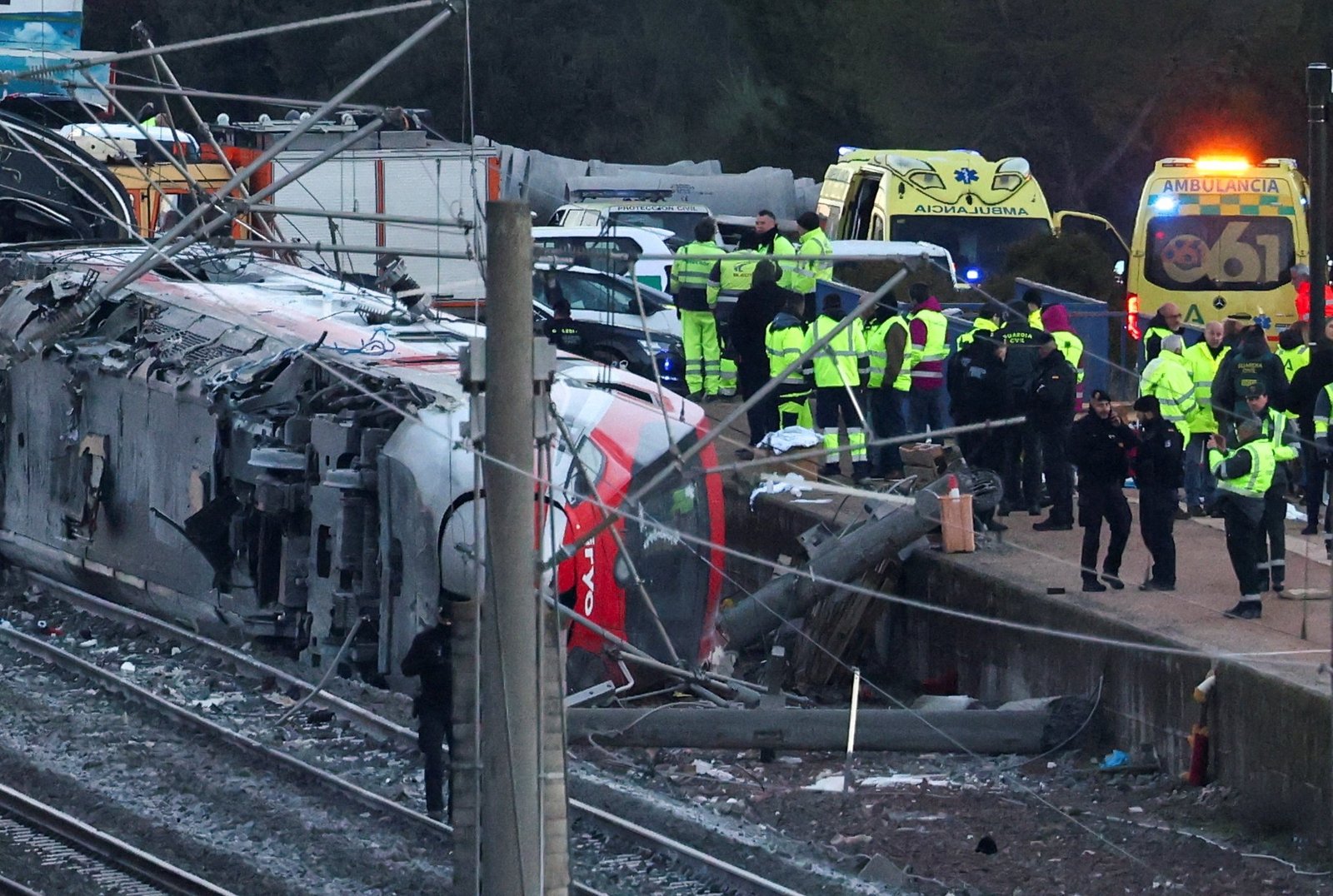
A tragic high-speed train collision in southern Spain has left at least 21 people dead and dozens more injured, marking one of the nation’s most severe rail incidents in recent memory. The crash occurred on Sunday evening near the town of Adamuz, in the province of Córdoba, when a Málaga-to-Madrid service derailed on a straight section of track and veered onto the adjacent line, colliding with an oncoming Madrid-to-Huelva train.

Spain’s rail infrastructure manager, Adif, reported that the Iryo-operated train (a Frecciarossa 1000 model capable of speeds up to 400 km/h) derailed first, causing its carriages to cross paths with the Renfe-operated service approaching from the opposite direction. The impact was devastating: carriages twisted, mangled, and in some cases overturned or pushed down an embankment, creating chaotic and hazardous conditions for emergency responders. Approximately 300 passengers were aboard the Iryo train, while the Renfe service carried around 100, totaling roughly 400 people affected.

Transport Minister Óscar Puente described the event as “extremely strange” and “baffling” to experts, noting that the derailment happened on a recently refurbished straight track segment—upgraded just last year as part of major infrastructure investments. No immediate cause has been identified, with officials ruling out obvious factors like sharp curves or poor weather. A comprehensive investigation is underway, involving rail authorities, police, and independent experts, though preliminary findings may take weeks or months to emerge.

Initial reports confirmed at least 21 fatalities, with Andalusian emergency services treating over 70 injured passengers, more than 30 in serious condition and several in critical care. Authorities warned that the death toll could climb as search-and-rescue operations persisted through the night and into the following day, with teams using heavy equipment to access trapped individuals amid the wreckage. Survivors recounted terrifying moments: one passenger likened the impact to “an earthquake,” with people hurled from seats amid screams and flying debris. Aboard the struck Renfe train, the driver was reportedly among the victims.

Prime Minister Pedro Sánchez expressed profound sorrow, calling it “a night of deep pain” for Spain. King Felipe VI and Queen Letizia conveyed condolences to grieving families and wished the injured a full recovery. Solidarity messages arrived from European leaders, including French President Emmanuel Macron and European Commission President Ursula von der Leyen.

Emergency services mobilized swiftly, deploying firefighters, paramedics, Red Cross volunteers, and helicopters. The twisted metal and difficult terrain posed major challenges, forcing rescuers to prioritize amid limited access. Counseling support has been offered to families and survivors. Rail traffic on the key Madrid-Andalusia line was halted, with stations remaining open overnight to assist stranded travelers and relatives seeking information.

This disaster revives painful memories of Spain’s 2013 Santiago de Compostela derailment, which claimed 80 lives. As the nation mourns and investigators probe what went wrong on a modern, high-safety line, the focus remains on supporting victims and preventing future tragedies.

Continue Reading
Click to comment

Leave a Reply

Your email address will not be published. Required fields are marked *

General

TikTok Seals Landmark Deal to Spin Off US Operations, Ending Years of Ban Threats

Published

on

f2dae84f7d10c591d8495f13feb5f0f0e5385770

TikTok has finalized a major agreement to restructure its US business, allowing the short-video app to keep operating in the country after years of intense political scrutiny and national security worries tied to its Chinese owner, ByteDance.

The deal creates a new, independent US entity—known as TikTok USDS Joint Venture LLC—separate from ByteDance’s global operations. This move addresses long-standing US government concerns that the Chinese government could access American user data or manipulate the app’s recommendation algorithm.

TikTok, which has over 200 million users in the US, faced repeated threats of a nationwide ban under both the Trump and Biden administrations, including a 2024 law that would have forced ByteDance to divest its US operations or shut down the app.

Key elements of the finalized arrangement include:

  • A majority-American board and US-based leadership overseeing the new entity.
  • Oracle, Silver Lake, and Abu Dhabi-based MGX each holding significant stakes (around 15% each for the main investors), with ByteDance retaining a minority 19.9% ownership to stay below legal thresholds.
  • US user data stored and managed securely on Oracle’s cloud infrastructure.
  • The platform’s famous algorithm licensed to the US venture and retrained solely using American user data, which may result in subtle differences in content recommendations compared to the global version.

TikTok and ByteDance have repeatedly denied any improper data sharing with Chinese authorities.

While the agreement meets core US demands for data protection, independent oversight, and reduced Chinese influence, it introduces operational separation that could affect the app’s integration with its worldwide ecosystem. Analysts are divided on whether this will noticeably impact user experience, content discovery, or the platform’s overall “magic”—with some predicting minimal changes and others warning of a potentially less vibrant feed.

The deal marks a pragmatic resolution to a high-profile geopolitical flashpoint in tech, preserving access to a key market for TikTok while setting a potential model for handling similar concerns with other global platforms. Reactions vary: supporters view it as a balanced win for security and free expression, while critics see it as excessive government meddling that could fragment the internet further.

For now, the app remains fully available to American users, creators, and businesses, though its future performance and evolution under this new structure will remain under close observation amid ongoing US-China tech tensions.

Continue Reading

General

EU Puts US Trade Deal on Hold as Greenland Row Reignites Transatlantic Strains

Published

on

XJZ2JZ66XJOA5I3ZP4X5ARC5DU

The European Parliament has paused approval of a major trade agreement with the United States, deepening tensions across the Atlantic following renewed remarks by US President Donald Trump about acquiring Greenland. The decision signals growing European concern over what lawmakers see as coercive trade behaviour and erratic diplomacy from Washington, even as global markets remain relatively steady.

The agreement, reached in principle in July during negotiations at Trump’s Turnberry golf resort in Scotland, aimed to resolve a year-long tariff standoff between the world’s two largest trading partners. It would have reduced US tariffs on most European goods to 15 percent, down from the 30 percent initially threatened. In exchange, the European Union pledged increased investment in the US and regulatory adjustments to support American exports.

However, the deal required formal ratification by the European Parliament—a process now suspended.

Speaking in Strasbourg, Bernd Lange, chair of the Parliament’s International Trade Committee, said lawmakers had “no alternative” but to halt work on the agreement after Trump linked fresh tariff threats to the Greenland issue. The announcement coincided with Trump’s speech at the World Economic Forum in Davos, underscoring the political weight of the move.

Trump’s renewed insistence that the US should take control of Greenland—a territory belonging to Denmark, a NATO ally—unsettled European governments and briefly shook financial markets. Although the president later claimed progress toward a “framework” understanding on Greenland and stepped back from immediate tariff threats against several NATO members, officials in Brussels remained sceptical, viewing the shift as tactical rather than substantive.

The suspension reopens the possibility of EU retaliation, including tariffs on up to €93 billion worth of US goods. These measures, unveiled last year in response to earlier American tariffs, were frozen while talks continued. Unless the EU extends the pause or revives the trade deal, the tariffs could take effect as early as February, raising fears of a renewed trade conflict.

European leaders have also signalled they may turn to the bloc’s anti-coercion instrument—a powerful mechanism designed to counter economic pressure from foreign governments. French President Emmanuel Macron has previously supported its use, indicating a tougher European response if US threats persist.

Despite the diplomatic fallout, markets reacted calmly after Trump’s announcement of a Greenland framework, with US and European stocks posting gains. Analysts note that investors have increasingly discounted the president’s rhetoric, giving rise to the phrase “Trump Always Chickens Out” to describe a pattern of aggressive threats followed by compromise.

Still, the stakes remain high. The US and EU together account for nearly one-third of global trade, exchanging more than €1.6 trillion in goods and services each year. Any prolonged disruption to this relationship could have significant global economic repercussions.

For now, the trade agreement remains stalled. European lawmakers say progress will depend on a clear move away from confrontation and toward cooperation. As one EU official privately remarked, patience in Brussels is running out. In a period of fragile global growth and intensifying geopolitical competition, the standoff illustrates how quickly economic alliances can become entangled in political ambition.

Continue Reading

General

Locked Exits and Deadly Delays: Karachi’s Gul Plaza Fire Claims Dozens in Preventable Tragedy

Published

on

images (100)

A catastrophic fire tore through Gul Plaza, a crowded multi-storey shopping mall in Karachi’s historic Saddar district, on Saturday evening, claiming at least 27 lives and leaving more than 70 people still missing. The blaze erupted suddenly and spread with terrifying speed across the densely packed complex, home to roughly 1,200 shops selling everything from clothing and electronics to household goods. Flammable materials, narrow aisles, and poor ventilation turned the market into a deadly trap. Survivors recounted harrowing scenes: choking black smoke that reduced visibility to almost nothing, deafening screams, people trampling over one another in panic, and desperate attempts to find a way out—only to encounter locked metal gates and blocked emergency staircases.

Official accounts and eyewitness testimony have exposed glaring safety violations at the heart of the disaster. Of the building’s 16 designated exits, only three were unlocked when the fire broke out, as management had already secured most entrances in preparation for the mall’s routine closing time. Several trapped victims managed to call relatives from inside, begging for help in final, heart-wrenching messages before losing contact. Rescue teams faced immense challenges: the structure is now dangerously unstable, with sections of flooring and walls collapsed, and thick smoke still billowing from the wreckage days later. Many recovered bodies are badly charred, requiring DNA testing and forensic identification, prolonging the agony for families gathered outside the cordoned-off site. Initial emergency response was also criticised, with the first fire brigade call reportedly arriving more than 30 minutes after smoke was first noticed—by which time the upper floors were already fully engulfed.

The tragedy has ignited widespread public outrage, protests, and demands for immediate accountability in Pakistan’s largest city. Relatives of the victims, survivors, and local residents have taken to the streets near the charred ruins, chanting slogans against negligence and corruption. Political leaders from across the spectrum have called for a thorough investigation and sweeping reforms, including stricter enforcement of building codes, mandatory functional fire-safety systems, regular inspections of commercial structures, and better training for emergency services. This is far from an isolated incident in Karachi—ageing markets and multi-level plazas have repeatedly turned into death traps due to illegal extensions, overloaded electrical wiring, absent sprinklers, and routine disregard for safety regulations. As grief-stricken families continue their agonising wait for news and answers, one question echoes across the city: how many more lives must be lost before fire safety is finally treated as a non-negotiable priority rather than an optional expense?

Continue Reading

General

Valentino Garavani: A Legacy of Timeless Elegance and Haute Couture Mastery

Published

on

valentino_1768853543267_1768853555017

Valentino Garavani, the legendary Italian fashion designer known simply as Valentino, passed away peacefully at his home in Rome on January 19, 2026, at the age of 93. Born in Voghera, Italy, in 1932, he co-founded the Valentino fashion house in 1960 and spent over six decades redefining luxury, glamour, and sophistication in the world of high fashion. His passing marks the end of an era for a designer whose creations dressed royalty, Hollywood stars, and global icons, leaving an indelible mark on the industry.

Renowned for his exquisite haute couture, Valentino mastered bold colors, refined silhouettes, and opulent fabrics that exuded effortless elegance. His signature “Valentino red”—a vibrant, unmistakable hue—became a hallmark of his vision, symbolizing passion and timeless allure. From breathtaking evening gowns to sophisticated tailoring, his designs graced red carpets, royal occasions, and prestigious events, blending impeccable craftsmanship with an innate sense of beauty.

Princess Diana was among his most devoted admirers, famously wearing a striking burgundy velvet and lace dress by Valentino in 1992, an image that captured her enduring style. Hollywood luminaries such as Sharon Stone, Halle Berry, Cate Blanchett, Anne Hathaway, who once called him “like a father,” along with Jennifer Lopez, Naomi Campbell, Gwyneth Paltrow, and Pedro Pascal, frequently chose his pieces for major appearances, underscoring his broad and lasting appeal across generations and continents.

After retiring in 2008, Valentino entrusted the creative direction to Pierpaolo Piccioli, under whom the brand flourished, preserving its reputation for imaginative luxury while evolving to captivate new audiences. Valentino’s runway shows during Paris Fashion Week continued to command attention, affirming the house’s ongoing influence in a dynamic fashion landscape.

Beyond garments, Valentino shaped fashion photography, red-carpet aesthetics, and the broader culture of style. As a mentor and inspiration to emerging talents, he proved that artistry, attention to detail, and genuine connections with clients could transcend time. His relationships with muses and wearers were built on trust and mutual admiration, reflecting a designer who crafted not just clothes, but unforgettable moments of grace and confidence.

Valentino Garavani’s journey from his Italian roots to the pinnacle of global fashion was defined by unwavering passion, dedication, and an extraordinary eye for beauty. His legacy endures as a celebration of elegance, haute couture, and the enduring power of timeless design, inspiring the fashion world for generations to come.

Continue Reading

General

US and UK Reduce Personnel at Qatar’s Al Udeid Air Base Amid Escalating Iran Tensions

Published

on

1cb8477e0207a3d4de11f0f01d06db40

The United States and United Kingdom have initiated a limited withdrawal of military personnel from Al Udeid Air Base in Qatar, the largest U.S. military installation in the Middle East, as a precautionary measure amid rising regional tensions linked to Iran’s ongoing crackdown on anti-government demonstrations.

Al Udeid Air Base, which serves as a critical hub for U.S. Central Command operations and hosts approximately 10,000 American troops along with around 100 British personnel, is seeing a partial reduction in staffing. Officials from both nations have described the moves as temporary and targeted, emphasizing that they do not signal a full-scale evacuation or major shift in posture. U.S. sources, speaking to media outlets including Reuters and CBS News, characterized the decision as a preventive step while President Donald Trump evaluates potential responses to Iran’s handling of the protests. The UK has similarly repositioned some of its forces, though the Ministry of Defence has refrained from detailed comment, citing operational security.

Qatar’s government has confirmed the personnel adjustments, attributing them to “current regional tensions” and reaffirming its commitment to protecting citizens, residents, and key infrastructure.

The developments coincide with widespread unrest in Iran, which erupted in late December 2025 over economic grievances including currency collapse and skyrocketing living costs. What began as demonstrations against inflation has escalated into broad calls for political reform, marking one of the most significant challenges to the Islamic Republic’s leadership since the 1979 Revolution. Human rights organizations report severe repression by security forces, with death toll estimates from the crackdown varying widely—ranging from over 2,500 confirmed by groups like the Human Rights Activists News Agency (HRANA) to much higher figures, potentially exceeding 12,000 according to some internal sources and activist reports. Thousands more have been detained amid allegations of unlawful killings, mass arrests, and excessive force, drawing condemnation from Amnesty International and other watchdogs.

In response to the violence, Iran temporarily restricted its airspace to most commercial flights, leading to rerouting by international carriers such as Air India and Lufthansa, and causing widespread aviation disruptions. Diplomatic fallout has included the temporary remote operation of the British embassy in Tehran and heightened caution advisories from the U.S. embassy in Doha. Several European countries have issued travel warnings urging citizens to depart Iran.

President Trump has issued strong public statements on the situation, warning Tehran of “very strong action” if executions of protesters proceed and indicating that U.S. intelligence suggests a recent slowdown in killings. Iran has countered by threatening retaliation against any U.S. military moves and accusing Washington of seeking pretexts for intervention.

Despite the rhetoric, diplomatic sources indicate no evidence of a large-scale withdrawal from Al Udeid comparable to preparations for past conflicts. Analysts view the limited personnel reductions as a signal of measured caution rather than imminent escalation, allowing Washington and its allies to mitigate risks while diplomatic and strategic options remain under review.

Al Udeid continues to play a pivotal role in U.S. regional operations, underscoring the base’s enduring strategic importance even as the situation in Iran evolves rapidly.

Continue Reading

General

India’s Operation Sindoor: Army Chief Reveals Two Key Turning Points That Forced Pakistan’s Ceasefire

Published

on

3qcmlu64_ians_625x300_05_September_25

New Delhi — Chief of Army Staff General Upendra Dwivedi provided the most detailed official account to date of Operation Sindoor, explaining the two decisive turning points that led Pakistan to seek a ceasefire during the brief 2025 military engagement.

Speaking at the Indian Army’s Annual Press Conference, General Dwivedi highlighted that the armed forces operated with full operational freedom to “act or respond,” guided by clear political and military directives. He credited India’s success to meticulous preparedness, rapid execution, and seamless tri-service coordination.

The two turning points, as outlined by the Army chief:

  1. The initial 22-minute precision strike(May 7, 2025): India targeted nine terror camps in Pakistan and Pakistan-occupied Kashmir (PoK) in a swift, coordinated operation lasting just 22 minutes. This caught Pakistan completely off guard, severely disrupting its decision-making process. General Dwivedi described the aftermath across the border as chaotic—marked by confusion, uncoordinated responses involving drones and missiles, and overall mismanagement. India, having achieved its primary objectives, responded in a measured and calibrated manner to avoid unnecessary escalation.
  2. Strategic mobilisation and clear signalling** (May 10, 2025): On the morning of May 10, all three Indian services received explicit instructions on actions to take if the conflict escalated further. While declining to disclose specifics, General Dwivedi noted that these preparations—visible through satellite imagery of Indian naval, air, and ground force movements—were unmistakable to Pakistan. Once Pakistani observers “connected the dots,” they recognised the high risks of continued fighting and the strategic advantage India held. This realisation prompted Pakistan to pursue de-escalation, leading to a ceasefire understanding via military channels.

General Dwivedi described Operation Sindoor as a textbook case of tri-service synergy executed under firm political leadership. He emphasised that India was fully prepared for a broader conflict if required, but deliberately chose restraint once its politico-military goals, neutralising terror infrastructure in response to prior attacks, were met.

The Army chief also expressed satisfaction with 2025 advancements in jointness, self-reliance (Atmanirbharta), and military innovation. His remarks reinforce India’s posture of strong deterrence: decisive action against terrorism without seeking prolonged conflict.

This account underscores how strategic surprise, operational speed, and visible readiness combined to compel Pakistan to back down swiftly, reshaping perceptions of escalation dynamics in the region. Operation Sindoor remains ongoing in spirit, with India maintaining vigilance against future provocations.


Continue Reading

General

India-US Trade Momentum Builds, Iran Protests Intensify, Modi-Merz Strengthen Ties, ISRO Faces Launch Setback

Published

on

images (96)

On January 12, 2026, several major international stories captured global attention, reflecting a mix of diplomatic progress, civil unrest, strategic partnerships, and space program challenges.

Newly appointed U.S. Ambassador to India Sergio Gor, shortly after arriving in New Delhi, announced that fresh bilateral trade talks between India and the United States would take place on January 13. Gor described India as America’s most vital and essential partner, expressing strong confidence in advancing negotiations toward a comprehensive agreement despite the complexities of India’s vast and diverse economy. He highlighted expanding cooperation across trade, defense, counter-terrorism, energy, technology, education, and healthcare, and voiced optimism that President Donald Trump could visit India within the next one to two years. India’s Commerce Minister Piyush Goyal confirmed the ongoing commitment to finalizing a balanced bilateral trade deal. Gor also noted that India would soon receive an invitation to join the U.S.-led Pax Silica initiative for silicon supply chains, which boosted positive sentiment around the talks.

In Iran, nationwide protests triggered by the collapse of the rial to historic lows and inflation rates exceeding 40-50% entered their third week. The U.S.-based Human Rights Activists News Agency (HRANA) reported at least 538 deaths—mostly among demonstrators—and more than 10,600 arrests since the unrest began in late December 2025. Independent verification has been severely hampered by government-enforced internet blackouts and communication restrictions. Protests continued in major cities including Tehran, Mashhad, and various bazaars, even as Iranian authorities claimed order had been restored and accused demonstrators of promoting violence. Reformist President Masoud Pezeshkian acknowledged the need to address economic grievances through measures like subsidies and credits, but firmly stated that actions threatening social stability would not be tolerated. The situation prompted U.S. President Donald Trump to say his administration was considering “very strong options”—potentially including cyber or military measures—in response to the crackdown, while warning Iran against any retaliation. Iranian officials countered by threatening reprisals against U.S. and Israeli targets in the region if provoked, raising the risk of broader escalation.

Prime Minister Narendra Modi and German Chancellor Friedrich Merz addressed the India-Germany CEOs Forum in Ahmedabad, emphasizing opportunities to deepen collaboration in manufacturing, green energy, defense, and bilateral trade, which now surpasses $50 billion annually. The leaders underscored shared democratic values, long-term strategic trust, and mutual economic benefits, with discussions also covering higher education partnerships, visa facilitation, and support for an India-EU Free Trade Agreement. The visit included participation in the International Kite Festival, highlighting cultural ties alongside business engagement.

India’s space agency ISRO faced a setback when the PSLV-C62 launch from Sriharikota experienced a deviation in its flight path during the third stage, leading to the loss of 16 satellites, including DRDO’s Anvesha and several commercial payloads. ISRO reported that the vehicle performed nominally in the initial stages before a disturbance in roll rates and trajectory occurred, and a detailed investigation into the anomaly is now underway.

These developments illustrate the fast-moving and interconnected nature of global affairs in early 2026, where trade diplomacy offers promise amid rising security tensions and ongoing technological pursuits.


Continue Reading

General

Tragic Landfill Collapse in Cebu City Claims One Life, Leaves Dozens Missing

Published

on

ap_69609fdf629a7-1767940063

A catastrophic collapse at a landfill in Cebu City, central Philippines, has resulted in at least one death and over 30 people unaccounted for, sparking an intensive rescue effort and highlighting serious flaws in the nation’s waste management systems.

The disaster struck on Thursday afternoon at the Binaliw Landfill, when a massive pile of garbage suddenly slid, engulfing sanitation workers in tons of debris. A 22-year-old woman was confirmed dead, while at least 12 injured individuals were rescued and taken to hospitals. Most of those missing are thought to be workers present at the site during the incident.

Rescue operations are ongoing but hampered by the precarious instability of the waste mound. Cebu City Mayor Nestor Archival emphasized the unique dangers, stating that the site differs from typical landslides, as digging from the top risks destabilizing lower layers and endangering anyone trapped.

Approximately 300 responders, from government bodies, emergency services, and volunteer groups, are involved, using excavators, fire trucks, ambulances, and specialized teams to cautiously probe the debris for survivors. Families of the missing gather nearby, enduring anxious waits amid reports of faint calls for help heard shortly after the collapse.

Investigations into the cause are underway, but officials have raised alarms about longstanding mismanagement. Councillor Joel Garganera noted that the facility falls short of sanitary landfill standards, functioning more like an open dump. Practices such as excavating soil from the waste hill and stacking new garbage atop it likely undermined its stability.

Spanning about 15 hectares, the Binaliw site handles waste for Cebu City, a key hub in the Visayas and surrounding areas. Like many urban centers in the Philippines, it struggles with surging waste volumes due to urbanization and inadequate alternatives.

The incident has intensified demands for better enforcement of environmental regulations, improved waste segregation, and safer disposal methods. For now, efforts center on locating the missing and averting additional tragedies in what has become one of Cebu City’s most devastating recent accidents

Continue Reading

General

Bottled Water Pricier Than Milk or Petrol in Venezuela: Portrait of an Ongoing Crisis

Published

on

venezuela-water-crisis-02-jef-190314_hpMain_16x9_992

Venezuela, endowed with the planet’s largest proven oil reserves, remains a stark example of economic paradox and hardship for the international community. A telling sign of this turmoil is the relative cost of everyday essentials, where a litre of bottled drinking water often exceeds the price of both milk and gasoline. This inverted pricing underscores the profound effects of prolonged political instability, policy failures, and external sanctions on the lives of ordinary citizens.

Currently, petrol remains heavily subsidized, making a litre extraordinarily cheap, sometimes equivalent to just a fraction of a US cent, or effectively negligible in cost. Milk typically ranges around the equivalent of a couple of dollars per litre in dollarized markets, while bottled water can surpass that due to shortages in safe tap water. Cooking oil fetches even higher prices. In a nation once renowned for its inexpensive fuel and abundant natural resources, these disparities reveal profound infrastructural decay: fuel remains affordable due to government support, but access to clean water suffers from crumbling pipes, power outages, and supply disruptions.

The roots of Venezuela’s downturn stretch back years. Hyperinflation peaked in the late 2010s and early 2020s, devaluing the bolivar to near uselessness and forcing people to haul wheelbarrows of cash for basic purchases. The government responded by lopping multiple zeros off the currency, but inflation persisted, devastating savings and plunging most of the population into poverty.

The human toll has been devastating. In the early 2020s, poverty rates soared, affecting over 90% of households in some estimates. Food scarcity led to widespread malnutrition, with reports of people rummaging through trash for meals. This sparked a massive exodus—one of the largest in modern historym with millions fleeing to neighboring nations like Colombia and Brazil.

As the local currency imploded, informal dollarization took hold, stabilizing prices in many areas, especially cities. By the mid-2020s, transactions increasingly occurred in US dollars, a trend accelerated when authorities eased currency controls.

At the heart of this extended crisis was Nicolás Maduro’s leadership, beginning in 2013 following Hugo Chávez’s passing. His administration oversaw sharp economic shrinkage, plummeting oil output, and heightened global isolation amid accusations of graft, rigged elections, and rights violations.

The state-owned oil giant PDVSA, formerly an economic powerhouse, faltered due to mismanagement, underinvestment, and sanctions. Production nosedived, stripping the government of crucial income. Paradoxically, Venezuela occasionally imported fuel despite its vast reserves.

In essence, the anomaly of water outpricing petrol is not merely a curiosity but a poignant emblem of breakdown: eroded public services, warped incentives, and relentless daily hardship. Venezuela’s commodity prices narrate a tale of profound institutional collapse, with lasting repercussions for its people and the region.

Continue Reading

General

The Missing Link Between Success and Relationships

Published

on

Copy of Copy of Copy of Copy of Copy of Copy of Copy of Copy of Copy of Copy of Copy of Copy of Copy of Copy of Copy of Copy of Copy of Copy of Copy of Copy of Copy of Copy of Copy of Copy of Copy (1)

The quality of our relationships is one of the most important aspects that often goes unnoticed in a world obsessed with metrics, productivity tools, and relentless ambition. Gurugram-based leadership coach, bestselling author, and winner of the WAHStory 40 Under 40 Award, Dhirendra Singh, believes that the gap between personal and professional growth stems from a lack of relationship development, both at work and at home. With over 22 years of experience as a leader and having trained more than 275,000 people in over 63 countries, Singh’s insights, outlined in his bestselling book “Rise in Every Relationship,” have already hit a milestone of 5,000+ Reader’s, demonstrating that performance, leadership, and well-being can be improved through better communication, emotional maturity, and clarity. As his book gains international attention and translations, including a soon-to-be-released Arabic version, the message Singh conveys is reaching a global audience: the key to true success lies in how we treat ourselves and others.

A Journey from Corporate Leadership to Purpose-Driven Entrepreneurship

The fast-paced world of corporate leadership was where Dhirendra Singh’s career began, as he served in various roles, including learning and development (L&D), sales, operations, and consulting. In the 20 years, he noticed that there was a repetitive problem of disconnection: as organizations were eager to spend a lot of money on performance strategies, they tended to forget about the human realities of relationships and communication. This void led to an ambitious shift to entrepreneurship, which is associated with such challenges as quitting the corporate job, dealing with unpredictability, and addressing doubts.

It did not stop Singh, who established a coaching practice on the notion that relationships are the key to success in life and business. This led him to the establishment of his coaching brand and the publication of a book titled “Rise in Every Relationship”, which encapsulates his philosophy of emotional clarity, accountability, and conscious communication. His work has now been available to a world audience, with clients and readers enjoying his pragmatic models and life experience. This move by Singh represents his fundamental belief: Sustainable success is not speed, but self-consciousness.

A Philosophy Rooted in Relationships as the Catalyst for Growth

The personal brand of Singh is based on the border of relationships, leadership, and performance, which provides a hybrid business model that combines high-touch engagement and scalable offerings. Its services involve one-on-one coaching, emotional intelligence and conscious communication building, corporate workshops, relationship-based leadership, keynotes, which inspire actionable change, and intellectual property, such as Rise in Every Relationship. Moreover, digital learning programs can be scaled, and thus his insights can reach a wide range of people.

The difference between Singh and his colleagues is that he tries to solve the issues instead of providing a superficial solution to the problem. The majority of issues in life and business are not strategy problems, he says, and are relationship problems. His style is supported by a solid background of corporate and coaching experience that integrates both the art of relationships and the application of leadership skills. This distinction has given him a reputation in the personal development industry of India, in which he has idols such as Dr. Gaur Gopal Das, Sandeep Maheshwari, and Ankur Warikoo who have made a distinct mark. However, the focus on the relationship-based growth by Singh is clear and specific, which creates a subtle approach appealing to both people and companies.

Inspiring Transformation Through Awareness and Better Conversations

Singh aims to change others by showing them that they do not need to reinvent themselves radically, but put in honest self-reflection and better communication. Instead, he says, you need to change how you relate, not change who you are. He equips people with the ability to follow awareness rather than reaction, clarity rather than conflict, and consistency rather than quick fixes through coaching insights in the real world and transformations of clients. His book Rise in Every Relationship is one of the foundations, providing practical means to enter personal and professional relationships and be more emotionally responsible.

To the future, Singh sees an ecosystem that is globally relevant based on relationship-based growth, in which leadership, performance, and well-being are elevated through mindful communication and emotional intelligence. He wishes to size this influence by increasing the number of books, formal learning initiatives, and organizational treatments that remake the way teams work and cultures prosper. According to him, healing and leadership go hand in hand when we learn to relate to having awareness and responsibility.

Dhirendra Singh can be a game-changer for people who want to improve their communication potential to become more effective leaders, learn to embrace emotional intelligence coaching, or discover their potential to change, both personally and professionally. Focusing on relationships first, he demonstrates that it is not only possible to have clarity, stronger teams, and meaningful success, but it is inevitable when we bring ourselves into any relationship.

Continue Reading

Trending

Subscribe To Our News Letter


Contact Us
First
Last

This will close in 20 seconds