Business
Who Really Pays for Luxury? Inside the Lives of India’s Artisans and the Fight for Fairness by Couture Brand Aksstagga
The Indian fashion and clothing industry has enamored the world for centuries, and currently, India holds a 63% share of the global textile and garment market. However, there is a side to fashion that rarely makes it into lookbooks or glossy campaigns. We all talk about big fashion houses and designers, but we almost never talk about the most important section of the industry: the hands that make the clothes—the artisans.
Across India, thousands of artisans spend hours stitching, embroidering, dyeing, and finishing garments that eventually sell for prices they could never afford themselves. Traditional embroidery techniques like Chikankari and Zardozi require hundreds of hours per garment, depending on complexity, because each stitch is done by hand and cannot be rushed. A single lehenga panel can take nearly a month to complete, demanding patience, strength, and extraordinary precision. Many home-based artisans work irregular hours around household duties, which means their embroidery work often extends late into the night. Their labour sustains the industry. And yet, despite forming the backbone of India’s luxury and couture ecosystem, their houses remain underpaid, and their contribution remains hidden behind garments that travel far beyond the neighbourhoods where they were made.
This is not a problem limited to one craft or one region. Nor is it unique to a handful of brands. The uncomfortable truth is that much of the fashion ecosystem, luxury included, has been built on structures that vastly undervalue this unfathomable labour that the artisans provide to bring the designers’ art to life. Low wagesare justified by “market rates.” Long hours are absorbed into informal systems. Middle layers that dilute payment before it reaches the hands that actually do the work. These practices are normalised so deeply that they are rarely questioned, let alone challenged.
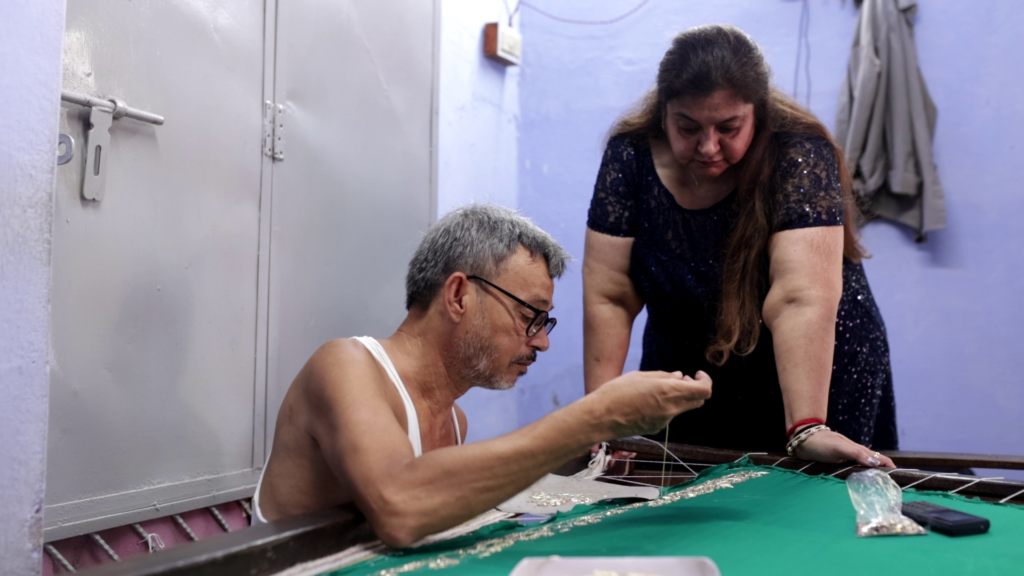

Anjali Singh Goel, founder and creative director of couture brand Aksstagga, knows this world intimately. Being in the garment industry for more than two decades before starting Aksstagga, she has navigated these networks herself, moving from center to center, home to home, trying to understand how work flowed and where it stopped. What she discovered over time was not only a lack of fairness but also corruption deeply ingrained in the industry culture.
“Boutiques and fashion houses often assume artisans are being paid because money is leaving the brand,” she says. “But somewhere between the brand and the worker, it gets stuck. And the person doing the work never sees what they deserve.”
In many cases, women artisans are restricted by geography and circumstance. Travel is not always an option. Work has to happen within their neighbourhoods, often inside their homes. This decentralized system is not something brands created; it exists because it has to. However, what brands do control is how they engage with it. And that is where most fail. Because work happens out of sight, it becomes easier to look away. Timelines remain rigid. Payments remain inconsistent. The burden of adjustment falls entirely on the artisan. When delays happen, they are blamed. When quality is exceptional, it is taken for granted.
Aksstagga operates within this same reality but refuses to treat it as inevitable. Anjali believes artists can only produce superior quality art when they can work unburdened from the stress of livelihoods, when their minds are free to be creative. She insists on paying among the highest rates she can sustain, even when margins tighten. She actively seeks out trustworthy intermediaries and managers, knowing that removing middle layers altogether is not always practical, but monitoring them is essential.
Moreover, at Aksstagga, timelines are shaped around real lives rather than factory schedules. Many artisans the brand works with are widows or primary earners, supporting entire households through their craft. So, Aksstagga makes sure that their work is flexible enough to fit around caregiving, health, and domestic responsibilities.
Equally important is what Aksstagga does not do. It does not take shortcuts to cut costs, such as using machines for the majority of the stitching and calling the cloth “handcrafted,” as many other brands do. Every single stitch on an Aksstagga design is crafted by hand and done by artisans employed by the company. It also does not pressure artisans to meet impossible targets in the name of speed. These choices may seem bare minimum, but unfortunately, most brands in the market don’t treat them as such.
“There is a lot that happens in this industry that people don’t want to talk about,” Anjali exclaims. “But pretending it doesn’t exist doesn’t protect anyone.”
Anjali is also clear that long-term change cannot come from brands alone. Systemic change requires government involvement, training centers, social security, fair wage benchmarks, insurance, and formal recognition of artisans as workers rather than informal labor. Initiatives like ODOP, which recognize Chikankari as a defining craft of Lucknow, are steps forward, but they need deeper implementation.
“If we want this craft to survive,” Anjali says, “the people behind it need more than appreciation; they need protection from exploitation.”
Real change, Anjali believes, is rarely glamorous. It happens through difficult conversations, honest accounting, and daily choices that are easy to compromise and harder to uphold. By centering artisans within its ethics and building systems that acknowledge their reality, Aksstagga offers a vision of luxury that holds everyone from designers to policymakers accountable.